
Why Exploitation Matters as Much as Science
Horizon Europe projects are not funded to produce reports that gather dust on institutional servers. They are funded to generate knowledge, technologies and systems that create real impact in the real world. For CiROCCO, that means ensuring the project’s sensing infrastructure, data services and algorithms have a credible path from prototype to product.
InoSens combines expertise in dissemination and communication, exploitation strategy, business planning, and environmental intelligence. Within the CiROCCO EU Project, InoSens plays a dual role — contributing to the Serbian pilot activities while also leading the project’s impact maximisation and exploitation efforts as the partner responsible for Task 5.3: Coherent Business Models, Exploitation Activities and Market-Entry Preparation.
From Four Concepts to Three Viable Services
CiROCCO began by exploring four candidate service verticals, each with its own market landscape and customer base. As the work progressed, InoSens applied a structured maturity assessment — weighing technology readiness, market pull, regulatory drivers and the strength of the underlying pilot evidence. That analysis led the consortium to concentrate its commercial effort on three verticals where the path to market is clearest, while the fourth — greenhouse-gas and particle-emissions modelling — was retained as a scientific capability rather than carried forward as a standalone commercial offering at this stage.
The three prioritised service verticals
Renewable Energy Planning — targeting solar park operators and energy utilities in arid regions, with the Benban Solar Park in Egypt as the proof-of-concept reference. The global solar sector’s exposure to dust-driven performance losses is measured in billions of euros annually.
Air Quality Early Warning — targeting municipal authorities, national health agencies and occupational health regulators, with the Idalion pilot in Cyprus demonstrating the model. The market for air quality data services across Southern Europe and the MENA region is growing rapidly under the EU’s Zero Pollution Action Plan.
Land Use and Ecosystem Management — targeting national forest services, conservation agencies and regional governments, with Vojvodinašume in Serbia as the reference customer. This vertical aligns with the EU’s Biodiversity Strategy and Soil Strategy.
The scientific foundation for emissions modelling, built on the CSIC pilot work in Spain, remains part of CiROCCO’s knowledge base and can be revisited as the technology and the carbon-market context mature.
The Business Model: Structuring for Sustainability
D5.5 — the initial Business Model and Market-Entry Plan — was delivered by InoSens at the project month 11. Using the Business Model Canvas as a structuring tool, it set out the value propositions, customer segments, revenue streams, key partners and cost structures for CiROCCO’s commercial future.
The model envisions a consortium-based commercialisation approach that draws on the complementary strengths of the partners. EBOS acts as the hardware champion, responsible for sensing-node manufacturing and deployment, while INTRA serves as the platform champion, providing the cloud infrastructure and data services. This commercial core is underpinned by the consortium’s research and technology partners — including the University of Cyprus (UCy), the National Observatory of Athens (NOA), and the Institute of Communication and Computer Systems (ICCS) — whose work on atmospheric and dust modelling, algorithm development and scientific validation gives the services their credibility and accuracy. The pilot partners, in turn, act as anchor customers and regional gateways to their respective markets.
Financial projections in the plan cover a three-year post-project commercial trajectory, giving the consortium a clear view of the investment required and the revenue potential achievable.
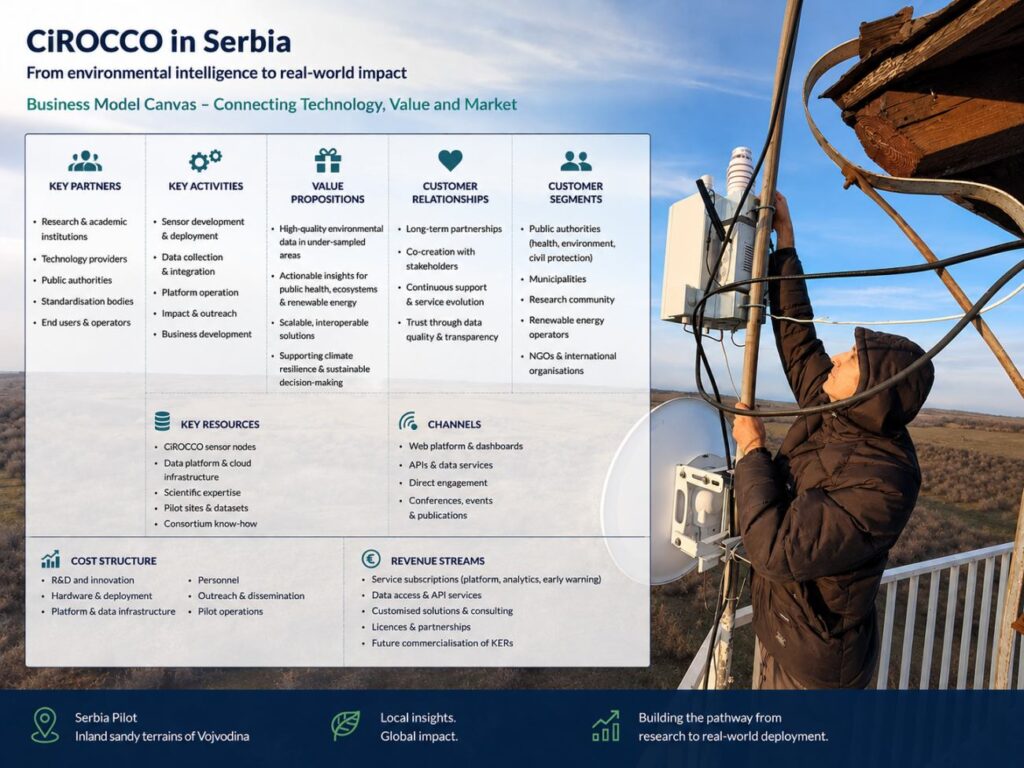
Serbia Pilot: Local Knowledge, Global Relevance
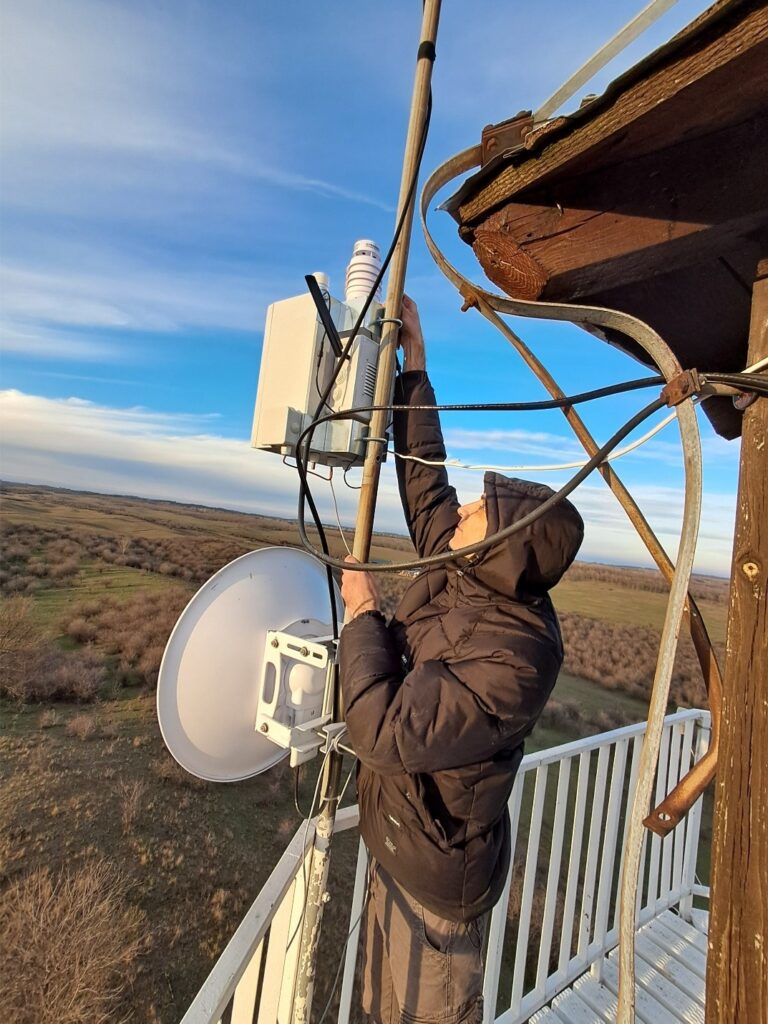
Beyond its commercial leadership role, InoSens contributes directly to the Serbia pilot. It brings local expertise in environmental monitoring and ecosystem management in the inland sandy terrains of Vojvodina (Deliblatska peščara), supporting the co-design of services for land, forest and protected-habitat management together with local stakeholders under Task 4.4.
Its work under Task 5.2 (Capacity Building and Policy Outreach) has also included engagement with Serbian national authorities on the policy implications of CiROCCO’s monitoring capabilities — contributing to the project’s ambition of informing environmental governance at both national and EU level.

From Project to Ecosystem
CiROCCO’s commercial ambition, as shaped by InoSens, is not to create a single product but to build an ecosystem: a network of operating environmental-monitoring services across arid regions, connected by shared technology standards, common data infrastructure and durable market relationships.
The final exploitation plan, D5.6, formalises this ecosystem vision. It defines the governance structures, IP arrangements and partnership models that will enable CiROCCO to scale beyond its initial pilot sites to new geographies and new customer segments.
This is how Horizon Europe investment creates lasting impact: not through research outputs alone, but through the commercial infrastructure that carries them forward.
Explore CiROCCO’s exploitation approach and impact strategy: